Songs that came a long way
by
Mike Daly
The
Age
December
4,
1992
Original article: 
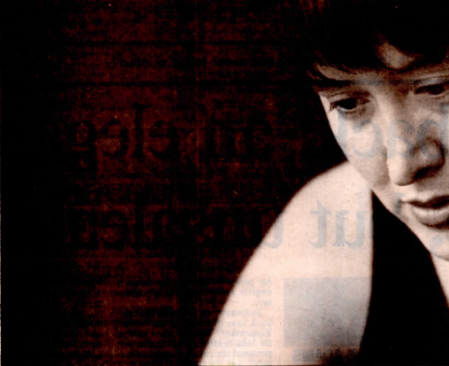
The cover of Michelle Shocked’s recent Arkansas Traveler album pictures the Texan-born singer/songwriter in theatrical backwoods set. The songs were the result of a recording odyssey, with the cream of American country and folk musicians from barns and parlors in the American South to metropolitan studios, and as far apart as Dublin and Sydney (the latter during her March 1991 tour here).
But it is the message Ms. Shocked included on the inner sleeve, about “blackface minstrelsy,” that provides the key to her current musical preoccupation. She talked animatedly this week about the genre, which developed over two centuries from Afro-American roots, was equally popular in Europe during the 19th century, and provided the springboard for jazz and popular music.
The controversial image of a white man “blacking up” has, she explains, confused this musical genre. “If you can decide whether minstrelsy is black or white, fine, but I see it as a fusion and that is a real direct tradition my music comes out of,” she says.
“Its roots were in northern American and European cities, but its history has been subject to so much revision. From the earliest days black, as well as white, entertainers were involved in blackface minstrelsy, so where do you start to unravel it?”
She has established a reputation as a strong-willed artist in an industry renowned for exploiting female performers as sexual stereotypes. But she is also generous in her acknowledgement of musical influences.
On Arkansas Traveler, Michelle Shocked credits her father, Bill Johnston, 50, a self-taught mandolin player, as the inspiration for her musical direction. At 16, she ran away from home in Austin, Texas, to find him. He performed on her first Australian tour and appears on the new album.
This year she married journalist Bart Bull, author of a history of blackface minstrelsy called, ‘Does This Road Go to Little Rock?’ and his detailed knowledge heightened her interest in the genre. “I had intended to title this third album in my trilogy Arkansas Traveler. I had no idea it was the name of a very popular blackface minstrel routine. When he pointed this out, I became fascinated to learn all about it until I got to the stage where I knew too much.”
She sees a correlation between the way black people were depicted in 19th century song and dance as “razor-toting and chicken-thieving” and the way the entertainment industry now promotes the image of “Uzi-toting, drug-dealers” in gangster rap.
“Our demand for authenticity has not really raised the standard of information. If Ice Cube says that’s how it is, we’re willing to believe it. But I say he’s sold his parent’s property value for the price of a Coon song – especially after the L.A. riots.”
Michelle Shocked says she is writing new songs but wants to break with her past and “experiment with new ways of telling stories” in the future. “I’m going to be surprised with the next album myself.”
She has certainly inherited her father’s storytelling skills; from her affectionate description of the part he has played in her career: “When I was small, he was building a boat in his backyard in the middle of a field in Texas; they called him Noah. He promised that when he’d finished it, he would take me sailing around the world.
“Well, he never finished the boat – he named it ‘Godot’ after the Beckett play – and became an armchair traveler in bluegrass music, playing the mandolin, and introduced me and my brother to the pleasures of homemade ‘jam.’
“So, he’s had a direct influence on the three most important things in my life: boats, traveling, and music.”
Michelle Shocked performs tomorrow night at the Concert Hall in what promises to be an exhibition of stringed virtuosity from herself (guitar, vocals) and fellow musicians Alison Brown (banjo), Ray Legere (fiddle) and Garry West (bass).
Added to Library on April 24, 2020. (501)
Copyright-protected material on this website is used in accordance with 'Fair Use', for the purpose of study, review or critical analysis, and will be removed at the request of the copyright owner(s).