Impending stardom stings sharp Shocked
by
John Mackie
Vancouver Sun
May
18,
1990
Original article: 
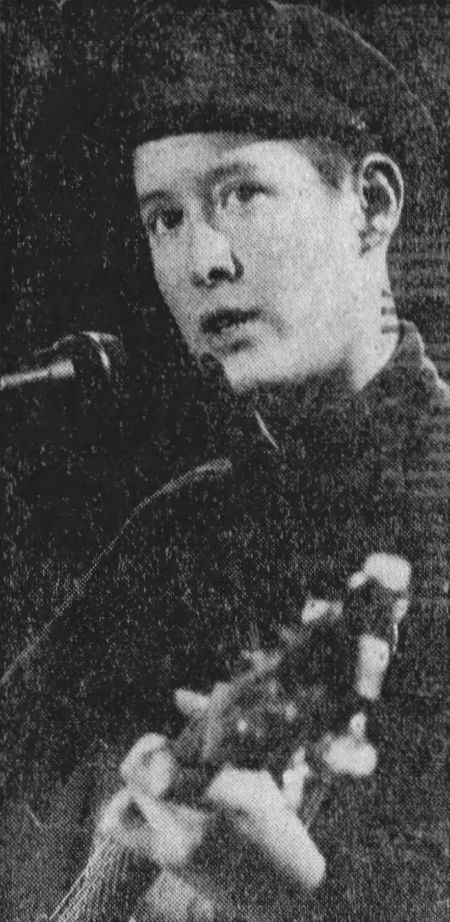
Signing to a major label, having a hit single, developing a dedicated live following and standing on the cusp of international stardom sounds like a dream come true to a lot of musicians – but to Michelle Shocked, it’s been a disorienting, and often disillusioning, experience.
Shocked carries her political beliefs up front, and she had hoped that by signing to a major label (PolyGram), the increased media exposure would help her push progressive causes. But she’s had to fight hard to retain her individuality within political movements that have tried to get her to jump on board the bandwagon, “trying to fit their agenda” rather than her own.
“I’m starting to feel that maybe there are reasons why you don’t always want to put your politics in front of your music,” says Shocked over the phone from Minneapolis.
“We take a lot of encouragement from artists who are willing to put their career at risk by speaking honestly about their political convictions, but on the other hand I’m also seeing a certain type of animal who will further their career by expressing political convictions that toe a party line, or a certain politically correct line. I’m very cynical about it.”
Shocked prefers to talk and sing about matters she’s had personal experience with, like the homeless problem in the U.S.
“My agenda has very much to do with my own experiences, with, say, the squatting movement,” explains the Texas native, who says she spent several years on the streets of New York, San Francisco, and Amsterdam. “That’s where my agenda comes in for the homelessness issue, that’s where I have direct experience with it. For a writer, as long as you can speak from your own experiences, you’re on pretty reasonable ground. It’s when you start lacking experiences and start taking on ideology that anyone who has influence over you is gonna start to sound reasonable.”
Her song “Streetcorner Ambassador” grew out of her street experiences, but other tunes have a less obvious political base.
“I’m very inspired by politics,” says Shocked, who will appear at The Commodore Tuesday with her 10-piece Captain Swing band. “A lot of the songs on the new album are direct references to political inspiration, but the content is not political. (Don’t You Mess Around With) My Little Sister, even the [illegible] …fact it was inspired by my thoughts that there’s a war going on in Central America, and no one’s acknowledging it. You don’t hear about it, read about it, the U.S. giving millions of dollars in aid to the government in El Salvador. They’re doin' it with the arrogance of a big brother, who is making democracy safe for our hemisphere. It’s like, ‘don’t you mess around with my little sister.’”
When she first appeared in Vancouver at the 1987 Folk Festival, Shocked was a confirmed American expatriate living on a barge in London. The right-wing political climate in her native land drove her overseas, and she doubted she would ever return to live in the States. But she found she “couldn’t really address European culture,” and wound up moving to Los Angeles.
“I was feelin’ a little bit more optimistic after Reagan left office, because I didn’t recognize Bush to be the sort of demagogue that Reagan was,” she says. “That’s what drove me to despair with Reagan, was that he was lying, and people were so willing to believe his lies. There was no role for anyone to try to address the truth as they saw it.
“But it was very difficult for me moving back to Los Angeles, because one of the reasons that I left was I want to draw my own conclusions, and I need information to do that. But when I get media reports in the U.S. press that say, first of all, that Panamanian troops destroyed the area around Gen. Noriega’s headquarters, and two weeks later they retract and say, ‘Well, no, in fact, it was after all U.S. troops that killed all those civilians…’ it made me really feel that same kind of despair and frustration, tempered with a lot more cynicism.”
Musically, she has made rapid advances on the two PolyGram albums, Short Sharp Shocked and Captain Swing. She still has a strong folk/roots base, but her fluid vocals have also worked wonders on a number of jazz, blues and swing tunes. Producer Pete Anderson (who plays guitar in the Captain Swing band) has been a big influence in her musical development, but one of the main reasons she experiments with different styles is she just doesn’t like to be predictable.
“I toured solo for almost three years, and it had a lot of good things about it, it was very intimate, and I suppose you could say empowering. But after a while, people knew what to expect when they came to see me play. Anytime that I’m preaching to the converted…you can be sure I’ll choose to run in the opposite direction.”
Personally, she says she’s been “going through a sort of explosion of personal growth and understanding, maturity and awareness, pain…confronting a lot of things that I wasn’t willing to look at about myself and so forth.”
She’s also been coming to grips with parts of her past, including her upbringing. She feels “mixed reviews” when she goes back to Texas, where her family still lives.
“I love my family – my grandmother is there, and she’s going through some trials with cancer. And my father and brother (are there). But there’s also the bitterness and the sadness – my relations with my mother aren’t too good at this point. She actually tried to contact me when I played in Dallas, and I just wasn’t ready to see her.”
Shocked started having problems with her Mormon mother in her teens, which culminated when her mother had Michelle committed to a psychiatric hospital when she was 22.
“At that point, I just decided by not communicating with her, it would cut down the chances that she could ever get that close again.
Added to Library on May 2, 2020. (498)
Copyright-protected material on this website is used in accordance with 'Fair Use', for the purpose of study, review or critical analysis, and will be removed at the request of the copyright owner(s).