Shocked Texas Folk
Michelle Shocked. More than just another folksinger.
by
Wayne Robins
Newsday (Nassau Edition)
November
19,
1987
Original article: 
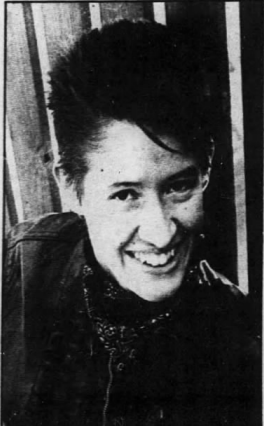
Michelle Shocked is a household word. That is, if your household belongs to a member of the Shocked family, or if it regularly tunes into Vin Scelsa’s Sunday morning show on WXRK-FM/92.3, better known as K-Rock.
For the last few months, Scelsa has been airing the cult item to end all cult items: an album by Shocked called The Texas Campfire Tapes, released only in England on the small (even by U.K. standards) Cooking Vinyl label.
The title is to be taken literally. An Englishman named Pete Lawrence met Shocked at a folk festival in Kerrville, Texas. He asked if he could tape her songs on his portable Sony. He and Shocked went off near the highway, where she sang a dozen of her songs. With Shocked’s approval, the tape was released on Cooking Vinyl.
The album is notable for its ambient sound: Shocked’s voice warbles (probably cause: low batteries), and her singing and playing is regularly punctuated by the unpredictable harmony of nearby crickets and the steady wheeze of trucks rolling down the road.
Shocked didn’t bring the trucks or the crickets to the Lone Star Tuesday night. But she did bring a saloon-hushing stage presence and a collection of precisely crafted songs.
Part of Shocked’s charm is in her look: she wore a black punk rock T-shirt and jeans and sported a severe flattop haircut that made her look like a male character from Archie comics a weeks out of the Marines.
Shocked sang in an unadulterated Texas accent. Her vernacular lyrics were enhanced by a mellifluous enunciation that made even the most prosaic situations sound poetic.
Shocked has the same unerring ear for the language and eccentricities of certain Texans as Bobbie Ann Mason does for Kentuckians of the generation between the coal mine and the factory. One Shocked song was about a man-and-woman evangelist team that she met in Austin.
“These evangelical types are like folksingers,” she said, “you say your piece and get out of town.”
Shocked’s topics aren’t limited to Texas people and places. “Fogtown” takes a sardonic view of San Francisco, a place where, she said, the fog rolls in “like nerve gas settling down on the trenches.” Stylists as diverse as Anita Baker, Peggy Lee, and Rickie Lee Jones – the latter of whom Shocked’s voice most strongly resembles – could, if they were ambitious, absorb a song like this in their repertoire.
Though Shocked’s tone was usually reasoned and persuasive, she occasionally vents outrage. One such song was Steve Goodman’s “[Ballad of] Penny Evans,” about the bitter young widow of a soldier in Vietnam. Though the song didn’t ring true: What kind of mother tears up checks when she’s got two babies to feed? Much more effective was Shocked’s own “Graffiti Limbo,” a tribute to the late New York [City] graffiti artist, Michael Stewart. “Where do you go when there ain’t no justice?” Shocked sang. It was Shocked at her best: committed and independent, yet relentlessly musical.
Added to Library on February 26, 2022. (504)
Copyright-protected material on this website is used in accordance with 'Fair Use', for the purpose of study, review or critical analysis, and will be removed at the request of the copyright owner(s).