She travels far from campfire
by
Gary Graff
Detroit Free Press
May
2,
1988
Original article: 
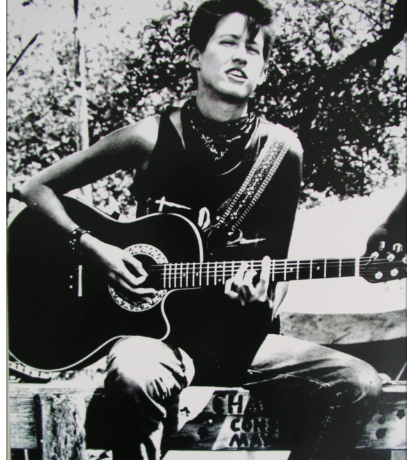
Michelle Shocked has a story to buoy the heart of any would be folksinger who likes to strum songs by the campfire.
Shocked was discovered at a 1986 campfire session in Kerrville, Tex., during her annual pilgrimage to that town’s folk festival. An Englishman named Pete Lawrence was sitting by the same fire and liked the spare narratives she was singing. So, he asked to record her songs on a portable tape recorder.
The tape turned out to be more than a personal souvenir for Lawrence. He went back to England, started a record label called Cooking Vinyl and turned Shocked’s tape – complete with crickets chirping and trucks roaring by in the background – into The Texas Campfire Tapes. The record became all the rage in England, and Shocked, whose record was recently released in the U.S., went from a nomadic nobody to a star.
“This certainly wasn’t my aim,” said the 26-year-old performer, who won’t give her real name. “My aim was to be sitting around in a little smoky café with a lot of other like-minded people, where anyone could hang out ‘til four in the morning.”
The success, however, has created contradictions in Shocked’s life. A self-described beatnik type, she grew up under the influences of her father, “a former ‘60s hippie,” and her stepfather, an Army officer who moved the family around the world, finally settling in Texas. Shocked described herself as a loner and a bookworm who began codifying political ideas while a teenager.
The politics don’t show up on The Texas Campfire Tapes, however. “I want to avoid the confessional aspect of being a singer-songwriter,” Shocked explained. “My songs have been stories, and I like that.”
Rather, Shocked’s stories center on populist thought, promoting community as a form of salvation, something she learned while squatting in San Francisco, Holland, and England. “I learned that as long as you have a community, you survived,” she said.
But with success and stardom, Shocked is struggling to stay true to her roots. She’s relieved to be touring the U.S. because “there was a lot of pressure in Europe. I never had the luxury of touring from the point of view of an ant looking up, where nobody knows who I am.”
As one of her publicists said, “Everything is happening very fast for her, and she doesn’t want to be caught up and treated like a regular pop star. She wants to try very hard to be honest.”
Still, being in the U.S. – and signed to an American label (Mercury) – means she’s fighting the corporate machinery she decries. As charming as the crickets and trucks are on Campfire Tapes, the company put a clause in her contract specifying that the next record has to be recorded in a first-class studio. And then there’s talk of radio play and hit singles, ideas as foreign to her as stardom was just a couple of years ago.
“I’m ‘anti’ a lot of this I’m involved in,” she admitted. “I’m trying to avoid this sort of strategic thinking. I think it tears up the community this kind of music needs to thrive in. On the other hand, like anyone else, when there’s an opportunity, it seems like you should take advantage of it.”
So, Shocked talks of using the success and the money she’s making to further her own ideas and keep inner peace. Though she now lives on a houseboat near London, she said she hopes to adopt a squatter or two and mentioned a desire to fund shelters and clubs for the homeless.
And on subsequent albums, she said, she hopes to “develop an aesthetic that would have an effect on popular taste” rather than be sucked into the music industry machine.
“I’m kind of familiar with the Jack London syndrome,” she said. “He was this socialist writer who couldn’t reconcile himself with success and shot himself in the head. I’m not worried about that, not if I keep a philosophy of putting my money where my mouth is, taking a lot of profits out of my hand and putting them towards things I support.
“But I do know that the bottom line is money, and I won’t have the opportunity to make (money) anymore if I don’t go along with the system. If I can do a little bit of good and know when to quit, that’s OK. It means the means will definitely justify the end.”
Added to Library on February 26, 2022. (502)
Copyright-protected material on this website is used in accordance with 'Fair Use', for the purpose of study, review or critical analysis, and will be removed at the request of the copyright owner(s).