Musician-Activist Shocked Singing at UNM Tuesday
by
Denise Tessler
Albuquerque Journal
October
3,
1988
Original article: 
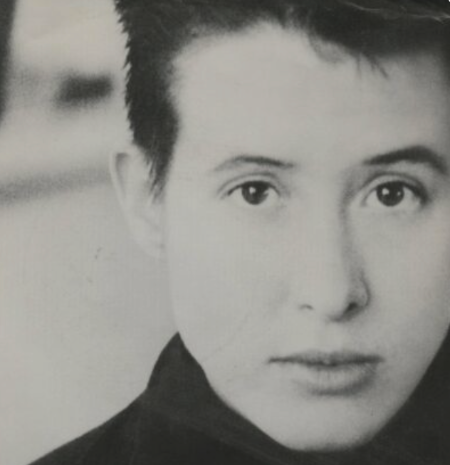
It’s no publicity shot. The photograph on the cover of Michelle Shocked’s first studio album, showing her being grabbed around the neck during an arrest by a San Francisco policeman, was reprinted from the San Francisco Examiner.
The charge was “conspiracy to commit a misdemeanor.” Shocked and others were blocking the sidewalk in front of a building owned by Diamond-Shamrock, a petroleum company.
“It was the time-honored tradition of making protest at a place and at a time when there was media attention focused on an event, in this case, the Democratic [National] Convention (of 1984),” Shocked said in a recent telephone interview.
“We targeted corporations who, aside from various offenses like profiteering in arms, had the common criteria of having contributed to both the Democratic and Republican campaigns.”
Shocked is neither a casual nor typical musician/activist. At the time of her arrest – she had been homeless since running away from an austere, fundamentalist mother and stepfather at age 16 – she was involved in the squatter’s movement.
She had to be almost pushed into the music business. “Music,” she said, “to me, is more a resource for the community, not to make money off of.”
Her first album, The Texas Campfire Tapes, was recorded on a portable cassette player beside a campfire at the Kerrville Folk Festival in 1987. She had merely shrugged assent when an Englishman asked if he could tape her. He released it on an independent British label, and it became a hit – truck noises in the background and all.
When offered a “real” record deal with PolyGram, she refused an advance offer of $130,000 on the principle that that much money should be spread around to more than one person and that she’d rather have artistic control.
The result, Short Sharp Shocked, is one of the best albums of the year. Produced by Dwight Yoakam’s guitarist/producer, Peter Anderson, the album is mature in its musicianship, simple and clean, mixing electric and acoustic in effortless shifts from boogie to country to blues, punk, and folk.
Shocked’s voice is a rich, pleasing alto occasionally reminiscent of Chrissie Hynde. Her songwriting features arresting metaphors and phrases drawn from her own experience.
On “Anchorage,” a folkie-pop tune, for example, she crafts her lyrics from a letter she received after finally “walking across that burning bridge” to reconnect with an old friend. “Memories of East Texas” starts off as a nostalgic journey, but one soon realizes that learning to drive “on red clay backroads” is a metaphor for her own emotional negotiation as a young girl. She sings: “What the hell’d ya let ‘em break your spirit for?/Their lives ran in circles so small/They thought they’d seen it all so/They couldn’t make a place for a girl who’d seen the ocean.”
Shocked thinks that rejection, and still being young enough to remember its sting, will help her communicate with Albuquerque-area youth when she performs a special concert Tuesday afternoon at the Bernalillo County Juvenile Detention Center.
“Those kids feel rejected more than anything. They have no voice for themselves, no resources and can only rely on other people.
“I can’t believe the opportunity I might have now, to use my own experiences (to communicate) because that was the hardest, the hardest time in my life. It was like the feeling of being a cat, when you take a cat to the second-floor window to see if they really do land on their feet. Well, that fall from (the ages of) 16 – 25 – it was terrifying.”
The message she hopes to convey is that someone does care and that it’s worthwhile to grow old and grow up. “Ghost Town,” on her Campfire album, says, “Direct your feet past all decay/To the place where things just get better with age.” Similarly, on the first cut of the new album, she sings, “When I grow up, I want to be an old woman,” a rather novel thought.
Shocked’s own role model, she said, is the fictional elderly woman in the movie Harold and Maude, who lived in an old bus and was “so alive and vibrant ‘til the day she died. That, to me, is the whole point.”
Shocked now lives in London on a houseboat; the legality of her mooring, she said, “is tenuous.” Her next-door neighbor is a man named Old Fred who lives in an ambulance and plants a garden on land he doesn’t own.
She left the U.S. after her arrests in 1984. In San Francisco, Shocked and fellow protesters were released on their own recognizance, but she spent three days in jail after similar protests during the Republican [National] Convention in Dallas.
It was then that Michelle, now 25, felt compelled to adopt the name Shocked (as in “shell-shocked”). “It left me very disillusioned … The response from the community, the press and so forth was not of support, not ‘You’re brave for going on that street to do what we only think about doing,’ but ‘You’re lunatic fringe; don’t you have any respect for people’s rights?’
“So, I’ve chosen to live in a country where dissent and voicing that dissent is a very time-honored tradition, where you don’t just get support from your own particular special interest group, but people realize the importance of supporting each other’s struggles.”
Added to Library on February 28, 2022. (445)
Copyright-protected material on this website is used in accordance with 'Fair Use', for the purpose of study, review or critical analysis, and will be removed at the request of the copyright owner(s).