Shocked Treatment
This firebrand wants to have fun
by
Wes Eischenwald
Boston Phoenix
May
11,
1990
Original article: 
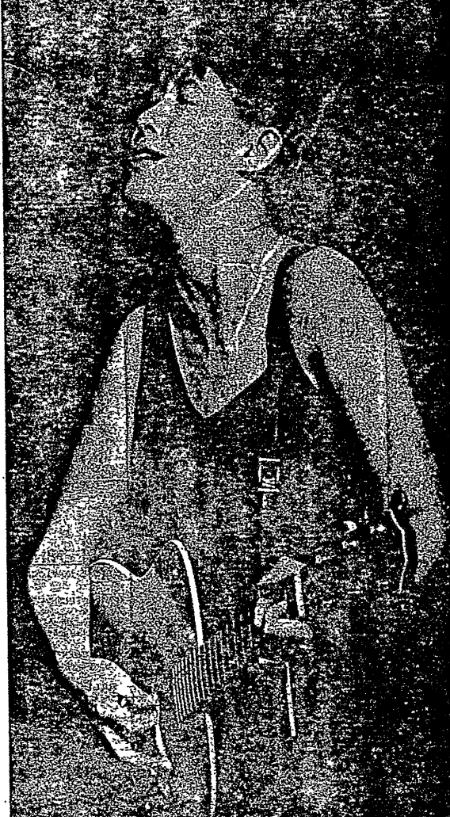
It’s about a half-hour into Michelle Shocked’s May 5 show at the Opera House. Michelle and her six-piece band have some of the crowd already dancing in the aisles. She’s done a few well-received numbers and Arlo Guthrie-type comic raps, and she’s halfway through “Hello Hopeville,” a catchy little number with a nice Sun Records feel. Then there’s some kind of disturbance down in the front rows. Three offending patrons are wrestled up the walkway and out the door by a phalanx of blue-shirted house security guards. Shocked finished the song, eyes darting sideways, and then for a couple of seconds just stands still, visibly discomposed.
"I’m not sure what’s going on here,” she says…, “but…”
A woman in the seats shouts something to her about those removed having tried to spoil everyone else’s good time.
“Yeah, but—a little anarchy never hurt nobody,” Shocked calls back. The crowd cheers. The show goes on, with an edge it lacked previously. The slight smugness in the air, bred of political correctness, is gone.
Whatever the incident’s circumstances, it’s not surprising that Shocked would feel sympathy for those removed by security forces. After all, this is a person who used a photo of herself being dragged away by riot police for the cover of her second major-label album, Short Sharp Shocked.
Toward the end of the set, Shocked quoted anarchist Emma Goldman’s famous dictum: “If I can’t dance, I don’t want to be part of your revolution.” Shocked may be a leftist, but she’s no Billy Bragg, whose infamous stage harangues carry equal weight with the music at his shows. Shocked was there to get the crowd to shake their booties, which they did. Or, as she said the ghost of Marilyn Monroe told her: “Honey, don’t preach to the converted—entertain the troops.”
Shocked’s politics are far more radicalized than her music, and the twain only rarely meet. She possesses the too rare combination of a strong social conscience and a great sense of humor. The pair are even more unusual when matched with her strong compositional sense, which is uncommonly radio-friendly for a folkie. Captain Swing (PolyGram), her current album, could have gotten airplay 15 years ago; it’s so full of slurred, twangy vocals and California Jug Band plucking that Shocked seems to have turned into Maria Muldaur with a butch haircut and bad attitude. (As a point of quasi-relevant trivia here, veteran sideman Freebo, who played bass on Muldaur’s homonymous 1973 album, has a tuba credit on Captain Swing. Hell, I half-expected Shocked to cover “Midnight at the Oasis” as a cassette-only bonus track and be done with it.)
Discovered via a chance Walkman recording of her singing and accompanying herself on acoustic guitar (which was later released as her first album, The Texas Campfire Tapes), Shocked has seemed like fortune’s child ever since: a cheerful extrovert with a dark undercurrent, playing the pop-star game while seeming to remain apart from it. Her absurdist sensibility has been her talisman. Take the whacked-out put-on of “When I Grow Up” (her set opener), the off-center perspective of “Anchorage,” where she tries to see herself as others do (and doesn’t sound egotistical about it), and “If Love Was a Train,” the point being, as she sings at the end, that it ain’t. Then add in the bonus points from her album covers. Following up 1988’s Short Sharp Shocked riot photo, the antithesis of a glamourous studio shot, on Captain Swing she’s caricatured by Jaime Hernandez of Love and Rockets comic-book fame.
If Shocked’s music doesn’t always live up to the rabble-rousing promise of its packaging, she’s still way more interesting than your standard issue folkie pud with an acoustic blues to talk through. The song where Shocked’s politics shine clearest is “Graffiti Limbo,” a number from Short Sharp Shocked about black New York graffiti artist Michael Stewart, who was, in Shocked’s words, “strangled to death in the presence of 11 white transit cops” who were later found innocent after a coroner lost the evidence.
Coming as it did shortly after the security incident, the song had a hard ring. In contrast, to her low-key, almost offhand delivery on the album, Shocked projected real anger, practically biting off the words one by one. Call it a case of life providing a fresh reminder to art.
Although it may have jump-started it, that episode didn’t color the show, which began with Shocked flinging herself on stage, dressed in black from boots to trademark cap and spouting one-liners like “Political correctness is a social disease.” In a sweet moment mid-show, she brought out her father, a shambling middle-aged coot named "Dollar Bill." They played a mandolin instrumental duet, making a high, pure, Appalachian kind of sound.
Strutting about, jetting water from a spray bottle over the front rows, Shocked exuded increasing enthusiasm. “It Must Be Luff,” as in sails, complete with a model ship demonstration, was too cutesy, but “(Don’t [You] Mess Around With) My Little Sister” and “Anchorage” brought Captain Swing home to port in style. By the end, Shocked, with the aid of Jim Pollock’s honking sax, Lee Thornburg’s trumpet, and John D. Graham’s pithy lead guitar, had almost ensured the fulfillment of the singer’s earlier wish: “Maybe if we’re lucky, there won’t be a dry seat in the house.”
Shocked left after dropping two more pearls of wisdom: “Our songs have three chords, four at the most—that’s the Michelle Shocked guarantee,” and “Music and politics are both much too important to be left to professionals like us.” Amen to both.
A big tip of the cap to show opener John Wesley Harding, making his Boston debut after work-visa problems snagged an earlier appearance with the Mighty Lemon Drops. J.W., a guitarist who describes himself as the bastard son of Dylan and Joan Baez, could add that he’s the spiritual half-brother of The Jazz Butcher, both share a similar logorrhea and irreverence.
A young, clean-cut Brit in paisley shirt and jeans playing solo acoustic, the guy is a hypocrite-hater’s friend. Dated or not, a high point of his set was “July 13, 1985,” a no-sacred-cows take on Live Aid and similar rock-star charity projects (“We own the world/We are rich bastards/We’re the ones who drive flash cars and don’t pay taxes”). Performing his minor radio hit “That Was the Devil in Me,” he added killing Don Henley to his list of misdeeds (so that’s a crime?), along with equating acid rain with corporate sponsorship of rock stars. Shouting “I’ll see you in Disneyland!” he strummed the six-string pyrotechnically fast before swinging into “Like a Prayer”—a version clearly superior to that platinum-blonde pretender’s original. As for the hootenanny-type rendition of Prince’s “Raspberry Beret,” done with the show’s second act, Poi Dog Pondering, let’s call it a draw.
Poi Dog, an eight-piece group from Hawaii by way of California who now live in Austin, are celebrating their second major-label album, Wishing like a Mountain and Thinking like the Sea (Columbia). They blend Jonathan Richman, childlike take on the world, with Van Dyke Park’s taste in orchestration and musical crossbreeding. Incorporating calypso, C&W (that’s city and Western), Sgt. Pepper-style pop, and blues, they played old-timey post-punk like granddad use to make. Band leader Frank Orrall is a good college-radio type singer, high-pitched and slightly nasal. Too bad they didn’t do the witty song about “The Ancient Egyptians,” who, among other things, “…didn’t have those ugly convenience stores or Texacos.” Unfortunately, without ol’ J.R. around, their own set sometimes fell flat on its own baroqueness.
Added to Library on April 18, 2020. (516)
Copyright-protected material on this website is used in accordance with 'Fair Use', for the purpose of study, review or critical analysis, and will be removed at the request of the copyright owner(s).