'Reformed' folk singer
Michelle Shocked turns from politics to bop
by
David Silverman
Willoughby News-Herald
April
13,
1990
Original article: 
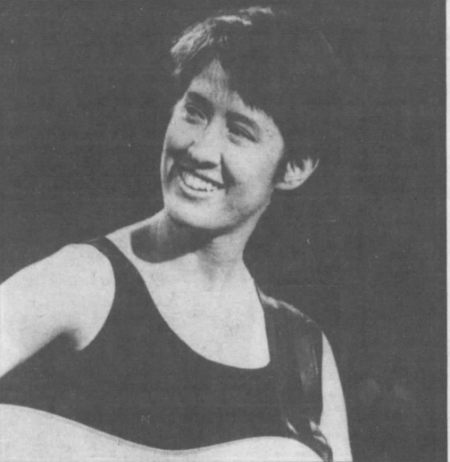
When Michelle Shocked turned her Chicago solo debut last March into an open-mike, political free-for-all, it wasn’t all that surprising. She had warned us.
“There’s no doubt that I carry a subversive agenda,” Shocked had said during a tense phone interview a week before the show. “I want to scare the (expletive) out of the powers that be.”
Chicago was embroiled in Art Institute’s “Flagmania” at the time and Shocked offered a bucket of gasoline to douse the flames. Instead of an encore, she moved aside, turning the stage over to the polemics of flag stompers, “Dread” Scott Tyler and Gregory “Joey” Johnson, who were at the center of the controversy.
Vietnam vets in the crowd spewed insults in cadence. The mike was opened to anyone with an opinion and six words to string together—until constant booing ended the exercises.
Michelle Shocked, self-appointed dissident and expatriate from East Texas, voice of a new generation, folker for the ‘90s, stood alone at stage left, smiling at the maelstrom’s fury—a grin that plainly said, “I’m scaring the powers that be.”
Now, eight months later, the voice on the other end of the phone is laughing.
“There’s still a subversive agenda, but I’m a little embarrassed and amused by all of that,” Shocked said. “I was doing some time when I was out in Chicago with Dread and Joey—we were pretty worked up.
“I don’t think this Michelle Shocked is talking like that anymore, scaring the powers that be and all.”
No, this Michelle Shocked is swinging.
On her brassy new LP, Captain Swing, Shocked has broken from the skateboard-punk bluntness and Texas folk of her debut, Short Sharp Shocked, as well as its associated politics of outrageous action.
The new album’s mix of bop, boogie-woogie, and fully orchestrated wanderings wears a 1940s patina but is overlaid in Shocked’s own twanging style.
Daring and unexpected, the new music is symbolic of Shocked’s wisened and tempered character. She is no longer “doing time” with Scott and Johnson, has traded her self-imposed exile on a London houseboat for a Los Angeles apartment she shares with her boyfriend, and is preparing for a moderate retrenchment.
“For the excesses of the last album, I’m sure I will have to pay my dues,” she said. “But on the other hand, I do believe I can stand by most of it. What’s happening now is merely a shift in emphasis.”
Until now, Shocked’s emphasis has been on motion. Though she is the only keeper of the complete tale of her vagabond existence (and her real name), guarding it like a precious locket, what she does tell makes for a kaleidoscopic if sketchy moving picture.
She takes 1962 as a year of birth, Dallas as a hometown. Her parents split up when she was 6, and though she lived with her mother and stepfather (an Army captain who converted the family to Mormonism), her summers were spent with her father, “Dollar Bill” Johnston. Shocked calls him a “hippie who could play a mean mandolin,” and the man who taught her to play guitar.
At 16, Shocked ran away from the family’s Gilmer, Texas, home—taking to the back roads of Texas rather than subject herself to her mother’s fundamentalist discipline. After time at a junior college and a month-long stint in a mental hospital at her mother’s hands (it lasted until the insurance ran out), Shocked left for good.
The mid-‘80s proved to be brutal schooling to sharpen Shocked’s activist edges, from her experience in San Francisco’s hard-core underground to fighting for the Squatters’ Movement in Amsterdam to being raped on a trip to Italy, then sequestering herself in a feminist commune before returning to Texas.
“It’s hard to say someone should go through that to learn about life and poverty and what it means to be homeless, but that was the way it worked,” she said. “There wasn’t any plan, but that was really at the heart of that culture. Things just happened.”
In the spring of 1986, while working at the Kerrville Folk Festival, Shocked spent evenings fireside, trading tunes with friends. Independent British producer, Pete Lawrence, stumbled upon the jams and recorded one of Shocked’s sessions on a Sony Walkman, complete with backing by crickets and the occasional pickup truck rolling by.
Lawrence released the crude recording in England that summer as The Texas Campfire Tapes, but by the time he’d finally found Shocked to tell her, the album was already in the Top 25 on the alternative charts.
A deal with PolyGram soon followed—though Shocked agreed to take only $50,000 of the company’s $130,000 advance, saying PolyGram should sign another artist with the difference. She then took up residence on the Thames, refusing to return to the United States.
“It was really important for me at the time,” she said. “I found the Reagan years too frustrating. There was little I could gain from enduring that kind of established indifference after fighting for so long.”
Her debut album, complete with candid cover art of Shocked being carried away by police at a 1984 demonstration, was hailed as the return of folk’s rebel conscience. Her music, steeped in Texas roots and brimming with political rancor, immediately made her one of rock’s “most important” new voices.
“I was definitely trying to create a perception of myself,” Shocked said of the album, her subsequent opening act for British folk activist, Billy Bragg, and later her own solo tour. “I was a caricature. It wasn’t that I was mocking people because I believe in what I was saying. I believe in radical politics.”
Added to Library on April 18, 2020. (502)
Copyright-protected material on this website is used in accordance with 'Fair Use', for the purpose of study, review or critical analysis, and will be removed at the request of the copyright owner(s).